
A Closer Look At Daniel and The Lions Den
 admin
Sep 2, 2026
125
0
admin
Sep 2, 2026
125
0
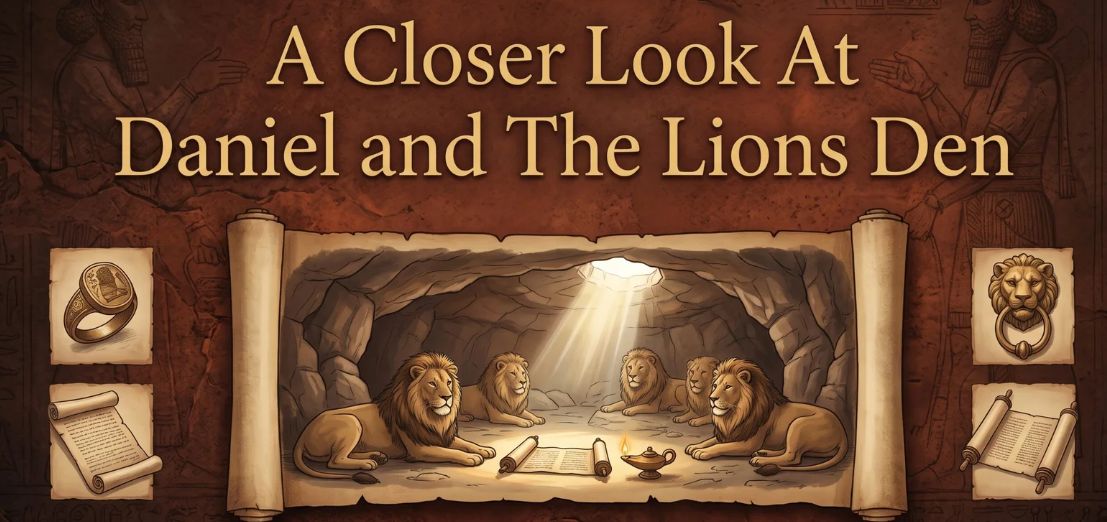
Daniel and the lions’ den is one of the most familiar stories in the Bible. Even people who rarely read scripture often know the broad outline.
A faithful servant of God is thrown into a den of hungry lions after refusing to stop praying. God protects him, the king rejoices, and Daniel emerges unharmed.
It is an unforgettable story told in countless Sunday Schools, but that can sometimes mean we miss important details.
When we revisit a well-known passage, our eyes naturally drift towards the details we already remember. In Daniel 6, that usually means the lions. Yet scattered throughout the chapter are tiny details that add depth, tension, and meaning to the story. Once we notice them, the account becomes less about a single miraculous night and more about a lifetime of faithfulness.
Here are seven hidden details that many readers overlook.
1. Daniel Was Probably in His Eighties
Most illustrations I have seen portray Daniel as a young man. He is usually pictured standing confidently among the lions, looking strong and energetic, almost as though he has stepped straight out of one adventure and into another.
The chronology suggests something very different.
Daniel was taken into exile by the Babylonians around 605 BC. The events of Daniel 6 occur after the fall of Babylon in 539 BC, during the reign of Darius the Mede. By this point, Daniel had spent decades serving foreign rulers and navigating the political upheavals of an empire that was constantly changing around him.
Most scholars conclude that Daniel was probably in his early to mid-eighties when he was thrown into the lions’ den.
That detail changes the story dramatically. Daniel is not a young hero proving himself for the first time. He is an elderly exile who has spent most of his life far from home. He has witnessed kings rise and fall, survived court intrigues, and remained faithful through decades of uncertainty.
The lions’ den was not the beginning of Daniel’s faithfulness. It was the culmination of it.
Many of us admire dramatic acts of courage, but Daniel reminds us that the greatest spiritual achievement may be enduring faithfulness over a lifetime. Long before he spent one night among lions, he had spent decades quietly trusting God.
2. His Enemies Could Find No Fault in Him
The crisis begins because Daniel is successful.
Darius plans to place him in a position of even greater authority, and the other officials resent it. Determined to remove him, they begin searching for evidence of corruption, negligence, or misconduct.
What they discover is remarkable.
Daniel 6 tells us they found no fault in him because he was trustworthy, neither corrupt nor negligent. The language covers both honesty and competence. Daniel was not enriching himself through his position, but neither was he careless in carrying out his responsibilities.
That combination is rarer than we might think.
Some people avoid wrongdoing but neglect their duties. Others work hard but compromise their integrity along the way. Daniel managed both. His faith shaped not only what he believed but also how he conducted himself in public life.
The most striking aspect of this detail is that the verdict comes from his enemies. These are not friends looking for reasons to praise him. They are opponents actively searching for reasons to destroy him. Yet even they are forced to acknowledge the quality of his character.
Long before Daniel entered the lions’ den, he had already built a reputation that spoke for itself.
3. The Trap Was Built Around His Greatest Strength
Unable to find any evidence of corruption, Daniel’s rivals reach an unusual conclusion. If they want to bring him down, they will have to use his devotion to God against him.
Most traps are designed around weaknesses. They exploit greed, fear, pride, or ambition. Daniel’s enemies have no such weakness available to them.
Instead, they target the one thing they know he will never abandon.
Their entire scheme depends upon Daniel continuing to pray. They understand that his relationship with God is not negotiable. They know exactly where he will refuse to compromise, and they are confident enough in his character to build their plan around it.
The irony is hard to miss. The quality that makes Daniel vulnerable in the short term is the very quality that makes him admirable thousands of years later.
His enemies saw his faith as a weakness to exploit.
History remembers it as his greatest strength.
4. The Open Window Was Not an Act of Protest
One of the most overlooked details in the chapter is Daniel’s open window.
When the decree is issued, Daniel returns home and prays with his windows open towards Jerusalem. Many readers assume this is an act of public defiance, as though Daniel is deliberately making a statement.
The text suggests otherwise.
Daniel prayed “just as he had done before.” This was not a new behaviour adopted in response to the decree. It was part of a long-established pattern of devotion.
But why Jerusalem?
The answer takes us back to the dedication of Solomon’s Temple centuries earlier. In 1 Kings 8, Solomon prayed that if Israel were ever conquered and carried into exile, God’s people could pray toward Jerusalem, and God would hear them.
Daniel was living inside that prayer.
Every time he opened those windows, he was acting on a promise. He was expressing confidence that God had not forgotten his people despite their exile. The direction of his prayer was not simply geographical. It was theological.
Many readers assume Daniel was looking backwards with nostalgia, but in reality, he was looking forward with hope.
The open window was a declaration that exile would not have the final word.
5. The Lions Were Not the Real Test
When we think about Daniel 6, our attention naturally settles on the den itself. The lions provide the drama, the danger, and the miracle.
Yet the decisive moment in the story happens much earlier.
It occurs when Daniel learns about the decree.
At that point, he faces a choice. He can temporarily alter his behaviour to avoid trouble. He can pray privately. He can wait a month until the decree expires. He can find a compromise that allows him to stay safe while technically remaining faithful.
Instead, he continues exactly as before.
There is no guarantee of rescue. No angel has appeared, and no miracle has been promised. Daniel simply chooses to remain faithful.
The real test was not surviving the lions. It was what Daniel chose to do the moment he learned about the decree. The lions are merely the consequence of a decision already made.
This detail is worth reflecting on because most acts of courage begin long before the dramatic moment arrives. They are usually rooted in habits, convictions, and choices formed over many years. Daniel’s response in the crisis reveals the character he had been developing throughout his life.
The lions merely revealed what was already there.
6. The King Had a Worse Night Than Daniel
One of the most surprising details in the story involves Darius.
Daniel spends the night in a pit surrounded by lions, while the king returns to his palace. We naturally assume that the king enjoys an easier evening.
The text says otherwise.
Darius fasts. He refuses entertainment and cannot sleep. Throughout the night, he is tormented by anxiety over the consequences of his own decree.
For ancient readers, this would have been a striking image. Kings possessed extraordinary privileges. Food, music, comfort, and servants surrounded them constantly. Darius voluntarily gives all of that up because his conscience will not leave him alone.
The contrast is remarkable. Daniel is physically trapped but spiritually at peace. Darius possesses all the power of an empire, yet spends the night restless and distressed.
The story challenges our assumptions about security.
Power does not always bring peace. Status does not always bring confidence. Comfort does not always bring rest.
Sometimes the most troubled person in the story is the one sitting on the throne.
7. The Sealed Stone Points Beyond Daniel
The final hidden detail may be the most intriguing.
After Daniel is thrown into the den, a stone is placed over the entrance and sealed with the king’s signet ring. The officials also affix their seals.
Historical evidence suggests these seals served an important purpose. The king wanted to prevent the officials from interfering with Daniel’s fate, while the officials wanted to prevent the king from secretly rescuing him. Neither side trusted the other.
The stone represented finality.
As far as everyone involved was concerned, Daniel’s story was over. Yet when morning comes, the stone is removed, and Daniel emerges alive.
For Christian readers, the imagery feels familiar. An innocent man is condemned despite his faithfulness. A stone is placed over what appears to be his final resting place. Authorities seal the entrance. Then, on the other side of what should have been certain death, life emerges unexpectedly.
The parallels are not exact, but they are difficult to ignore.
Early Christians certainly noticed them. Daniel’s deliverance became a symbol of resurrection hope and appeared frequently in Christian art and teaching.
The story points beyond itself.
It reminds us that God is able to work even when circumstances appear completely closed and hopeless.
More Than an Adventure Story About Lions
Most people remember Daniel because of the lions.
Yet Daniel 6 is ultimately about much more than a miraculous rescue. It is the story of an elderly exile who spent a lifetime cultivating integrity, prayer, and trust in God. When the moment of testing finally arrived, Daniel did not suddenly become faithful. He simply continued being the person he had already become.
That may be the most important hidden detail of all.
The chapter invites us to look beyond the dramatic miracle and notice the decades that came before it. Long before Daniel entered the den, he had learnt to trust God in ordinary circumstances. Long before he faced lions, he had developed habits of prayer. Long before he encountered a crisis, he had chosen integrity.
The lions did not create Daniel’s faith. They revealed it.
The miracle was not that Daniel survived one night among lions.
The miracle was that after decades of exile, disappointment, political upheaval, and pressure to compromise, he was still faithfully praying by an open window.
The den lasted a single night.
The faith that carried him through it had been built over a lifetime.














Comments (0)
Facebook Comments (0)