
Habits That Take You To The Top
 admin
Sep 9, 2026
138
0
admin
Sep 9, 2026
138
0
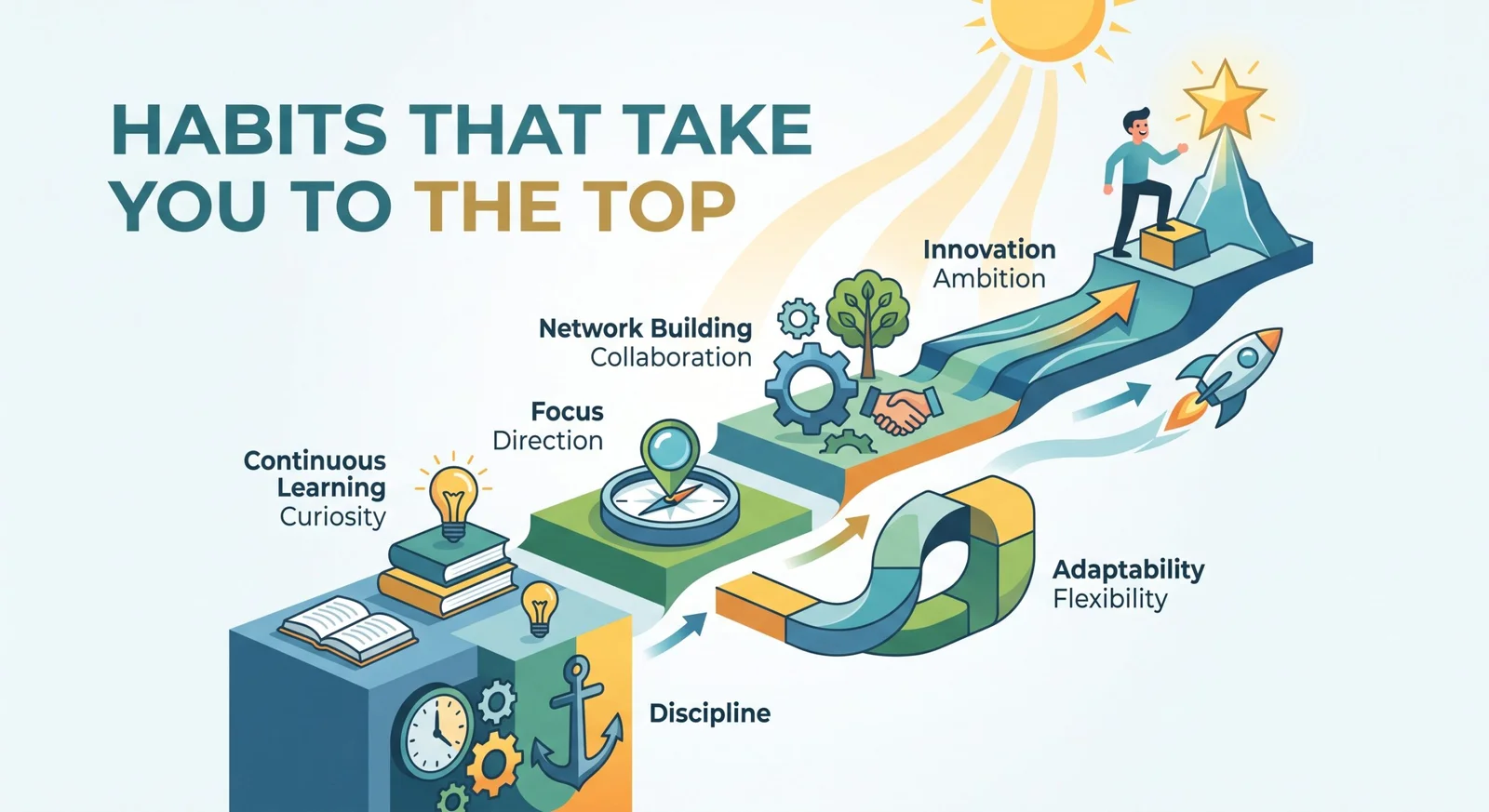
I have a little experiment for you. Think of the most successful person you know. Maybe someone in your family. Or someone you follow on the internet.
Five seconds.
Who were you thinking of?
Now think of something else. Did you respect them because of their degree? Their college marks? Their swanky job title? Their expensive clothes and them?
Likely not.
Maybe you thought of something else. Perhaps they were too confident. Maybe they knew how to talk to anybody. Maybe they kept their cool when everyone else went nuts.
Maybe they could walk into a strange room and somehow make themselves at home. Maybe they just knew how to do things. That changed how I view success.
I used to believe that success was largely about getting smarter. Get good marks. To learn more. Build an Awesome Resume. And, being a bit of a nerd myself, I naturally gravitated toward that path. But as I grew older, I realised something uncomfortable:
Knowing and being able are two different things.
You can know the answer and not know what you should do. You can be clever and still struggle to communicate. You can have a great plan and freeze when something unexpected happens. And you can be an introvert and not socially unaware.
Real world intelligence is different.
It is the result of observation, experience, communication, adaptability and knowing how to deal with people and situations. Over time, I began to actively develop those skills. And surprisingly a lot of them came from really basic habits. Not complex productivity systems. Just little things I began to do differently.
Here are 11 underrated habits that can quietly make you more confident, capable and likeable.
1. Pay attention when everyone else is distracted
One of the biggest things I started on was my observation. In school we are trained to focus on what is right in front of us. A trial.
But you don’t get a clearly written question in real life often. You have no teacher standing beside you saying:
“This is exactly what you need to notice.”
Sometimes the information that matters is someone’s tone. The look on their face. Their body language. The way they walk into a room. Who they speak to first One who listens to everyone. Who doesn’t speak. Who interrupts everybody. Who looks very uncomfortable.
That’s what people mean when they say “reading the room”. It’s a ridiculously underrated skill. I’ve started to do a simple thing when I get into a new environment.
I only watch the first 10 to 15 seconds. I glance around.
What’s going on? Who’s talking? How’s it going? What is important? What are people responding to?
Sometimes I even try to remember little things around me. It’s sort of like a mental snapshot.” It sounds stupid at first. But the more you practise noticing things, the more naturally you notice them. And finally, you’re not just seeing a room.
You are understanding it.
2. Remember small details about people
Here’s another habit no one talks about. Small things to remember. Someone says they are studying for a test. Learn it. Someone says their mother is unwell. You can ask her later.
One of my coworkers confides that she’s nervous about an upcoming presentation. Wishing them the best of luck. Someone nonchalantly tells you their favourite food. Remember that. These things are tiny.
But they make people feel special. And that’s something secretly loved by people. You don’t have to win over everybody.” You don’t have to be the funniest guy in the room. Sometimes you only need to remember what somebody told you three weeks ago to make you think:
Wow, this guy actually listens.
That’s a good one. Because people forget what you said. They may forget what you are wearing. But they will remember how you made them feel.
3. Learn to pause before reacting
I always thought confidence had to be about quick answers. Somebody says something. You respond immediately. You are criticised by someone. You defend yourself right away. You’re irritated. You reply instantly.
But I’ve come to see, slowly, that one of the most underrated forms of confidence is the ability to pause. You don’t have to answer everything right away. Sometimes the best response is:
Let’s see then.
Or just silence. By pausing, you give your brain a chance to catch up with your emotions. It stops you from sending that angry message. To argue for something unnecessary. “Say yes to something you don’t want.” Or doing something you will regret in five minutes. When you stop, you don’t lose power. “Sometimes you get it.
4. Do the boring thing yourself
I wish success were another way. If I could be home, scrolling through Instagram and then getting a message out of nowhere.
“Congratulations. You have won 1 Million $$$.”
Sorry, life hasn’t added that feature yet. The truth is much less glamorous. You gotta do the boring stuff. Me, I love creating content.
But there are other parts of the process I don’t like nearly as much. Tracking. Organisation of work. Getting a handle on money. Taking care of administrative duties. Researching boring stuff.
But those jobs still have to be done. And that was when I learned an important lesson:
You can’t outsource every inconvenience in your life.
Sometimes you gotta get your hands dirty. The uncomfortable tasks teach independence. They teach you how things really work. And they prevent you from being helpless when someone isn’t available to solve a problem for you.
5. Talk to people you normally wouldn’t
This one can be awkward if you are introverted. It did for me for sure.
But one of the fastest ways I’ve found to be more comfortable socially is just talking to more people. Not important people necessarily. Not stars. Not C.E.O.s.
Only people. Ask a question. Let’s talk it over. Turn to the person beside you. Ask about someone’s job. Hear their story. You don’t need a clever pick-up line. You don’t have to have perfect English. You don’t have to sound bright. You just have to be really interested.
The goal isn’t to be the loudest person in a room. It’s about feeling comfortable enough that when you actually have something to say, you’re not scared to speak.
6. Learn to listen without preparing your reply
That sounds very basic. But most people don’t really listen. They are waiting. Waiting for the other to finish so they could say what they wanted to say.
I have done this myself also.
‘Someone’s talking, and rather than really listening, my brain is planning my response. But I’ve been trying something different. When I talk to someone, I try to see their side before I think of mine. Sometimes I say:
“What do you mean?”
Or else:
“Why would you think that?”
And surprisingly, conversations become a lot better. People can tell when you really listen. There is a further advantage, too. You learn things when you listen carefully.
On people. On probabilities. On problems. About you. Sometimes the person talking to you is providing you with the information you need. You just have to pause long enough to hear the next sentence you plan.
7. Think about the consequences before saying yes
A small decision can create a chain of events you never saw coming. I learned this lesson the hard way. In my first job in finance I once made what seemed to be a very small mistake. So I added another 0.
At the time I didn’t realise how serious it could get. I was gone for a few days, and in that time the mistake became a much bigger problem.
The phones were ringing. The numbers didn’t add up. Budgets were impacted.
Other processes were suspended. “Just one zero” looked like it wasn’t just one zero anymore. And it was a chain reaction. It was then that I began to think differently about small choices. Before doing anything, ask yourself:
“So what happens next?”
Then:
“And what happens then?”
You don’t have to be perfect at predicting the future. Just know that your actions rarely happen in a vacuum. A small decision can have surprisingly big consequences.
8. Don’t take advantage of small mistakes
Say you go to a restaurant. One item worth $15 was accidentally missed from the bill.
You see it? No one else does. You could just pay and go.
“Their mistake. Not my problem.”
But I think these are the times that show character. The question is not:
“Will I get away with it?
The more interesting question is “what if everyone started thinking this way?”
Or the waiter is blamed. Maybe money is taken from his salary. Or the restaurant worker gets in trouble. Maybe the error is coming out of someone’s pocket.
Street smarts isn’t figuring out how to take advantage of every situation. It means to understand how the system works. And knowing when the smartest thing to do is just to do what’s right.
9. Put yourself in situations where you’re not good yet
Comfort is lovely. But it can be a trap too. If you always stick to what you’re already good at, you don’t get to find out what you’re capable of learning.
So sometimes, be a beginner. On purpose. Do something you’ve never done before. Talk to someone you don’t normally talk to. Learn something you aren’t good at. Do something you’ve been putting off. Embrace the unfamiliar, and make it yours. It sounds weird.
And that is the point.
There are things you learn in life that you don’t learn in books. Take Rajinikanth for instance. He was a bus conductor before he became a superstar. Or MS Dhoni, a railway ticket collector before he became one of cricket’s most successful captains.
Those experiences didn’t come from some well-oiled success curriculum. They were just life. But life shows you.
Be patient. Accountability. Humility. Communicating.
Dealing with difficult people. How to keep calm when things don’t go to plan. You can’t learn all that by watching motivational videos. Sometimes you have to feel it.
10. Change your approach when something isn’t working
There is a difference between being persistent and being stubborn.
Persistence says, “I’ll keep going.”
Stubbornness says, “I’m going to keep doing the very same thing even when it clearly isn’t working.
Life is always moving. Your plans will not work. People will let you down. There will be lost opportunities. What worked last year might not work this year. This is where flexibility comes in really handy. If Plan A fails, don’t spend your whole life mourning the loss of Plan A. Try Plan B. Then Plan C.
Change your strategy. Find out something new. Seek advice from someone. Reverse the problem. “It’s not about controlling everything.
The idea is to be flexible enough so that unexpected events don’t totally destroy you.
11. Keep learning even when nobody is forcing you to
School teaches you to learn because there’s an exam. College teaches you how to learn because you have an assignment. A job makes you learn because you have a deadline.
But in the end, no one may be watching over you. That’s where self-learning comes in handy.
Read it. Test. Ask questions. See people who are better than you. Learn from your mistakes. Learn from the talks. * Do things. And sometimes concede:
I don’t know.
That sentence can be very powerful now, because when you can finally say “I don’t know", you can finally start knowing it.
The world is changing too fast for us to be able to rely on what we already know. The one who keeps learning is adaptable. And the person who is flexible has a far better chance of surviving change.
The real secret isn’t being “street smart”
When I think back to my own development, I don’t think I suddenly became a different person. I didn’t wake up one day and become confident. It happened by small changes.
I began to pay more attention. Listen more carefully. Speaking to more people. Unpleasant jobs. Thinking about what comes next. Remembering small things well. Waiting before responding. Doing things that I didn’t do well. Learning from errors.
And slowly those little behaviours started to become me. That’s something I wish I’d understood sooner.
You don’t get confident waiting to be confident.
You get confident by carrying out things that make you uncomfortable enough times that they don’t feel so uncomfortable anymore. You don’t get street smart by memorising advice. You learn to be street smart by experience. You don’t become a good people person from reading one book. You get along with people by talking to them. And it isn’t just a matter of knowing more, either. You become valuable when you use what you know.
Degrees may open up opportunities. You can have an edge with knowledge. But once you are in the room, something else matters. How you think. The way you communicate. How do you handle pressure? How you treat the people. How fast you learn. Your adaptability.
And, maybe the most important of all,
whether you can really get things done.
Those are the habits people may never directly praise you for. But they are often the things that people quietly appreciate the most. Sometimes the most underrated habits are the ones that change your life with little noise.














Comments (0)
Facebook Comments (0)