
God Is In The Context
 admin
Sep 10, 2026
142
0
admin
Sep 10, 2026
142
0
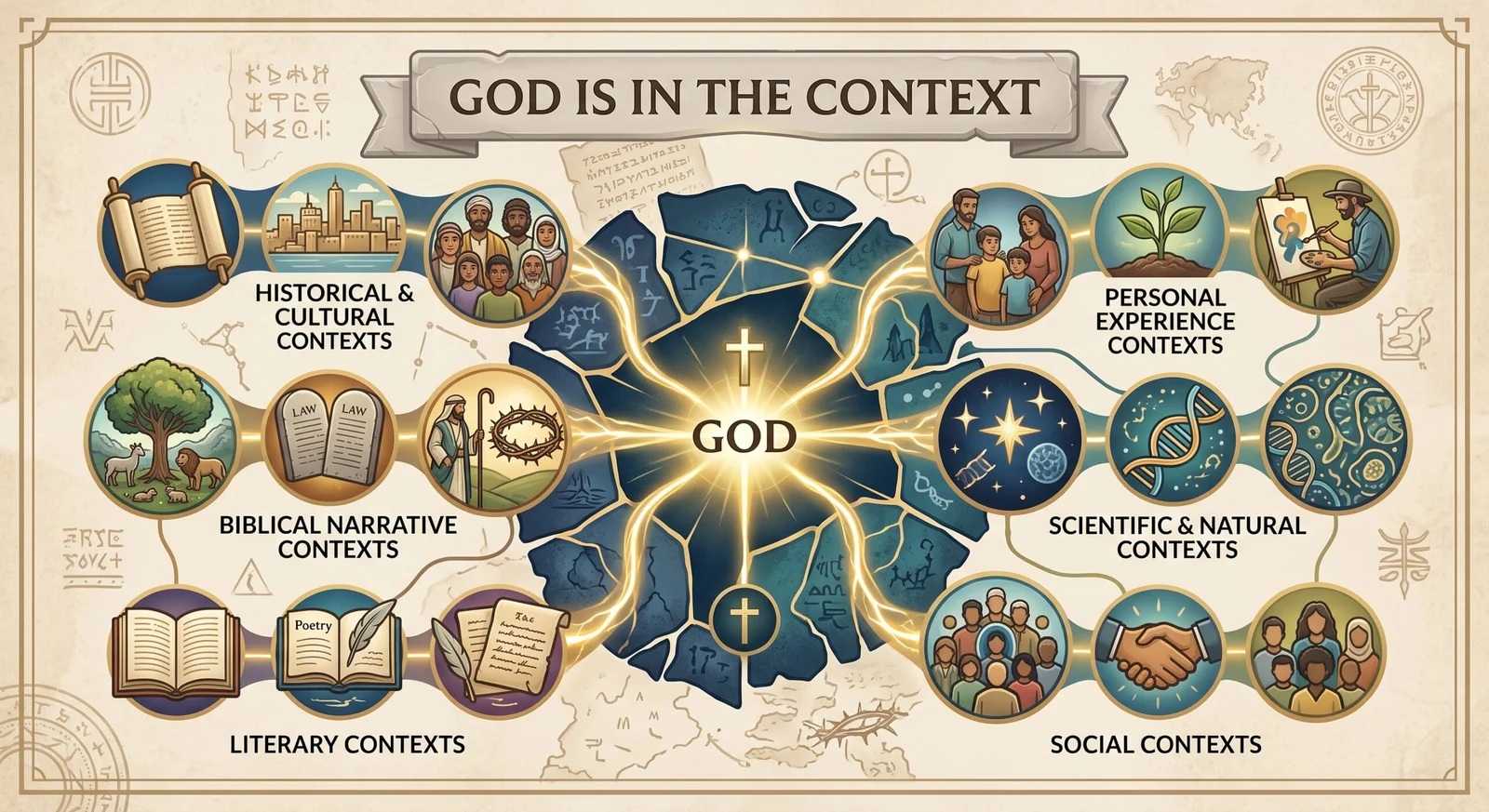
I learned to be wary of people who pick out one word or phrase from a story to flip an author’s meaning. I can’t count the number of times a preacher or evangelist would focus on one word in the Bible and weave it into an entire sermon that had nothing to do with what the passage they read from said.
For instance, one would take the word “love” from John 3:16 and riff on love, especially the part where they would remind us that love also means tough love, and tough love means you can’t forgive everyone willy-nilly, especially if they don’t ask for love, which means we’d proceed straight to hell if we died today and didn’t accept Jesus as our saviour.
I discovered how easily Christians misinterpret scripture in high school when I stumbled across a scripture used to prohibit drinking. But when I read that scripture, I learned they’d hidden half the story.
Or they would read Romans 6:14, “For sin shall no longer be your master, because you are not under the law, but under grace.” From that they would say grace is a gift from God and riff on grace until they reached the conclusion that God never intended grace for sinners, which means we’d proceed straight to hell if we died today and didn’t accept Jesus as our saviour.
You get the idea.
Finding the message we want in the scripture
I discovered how easily Christians misinterpret scripture in high school when I stumbled across the verse in First Timothy where Paul advises, “Stop drinking just water, but use a little wine for your digestion and your frequent illnesses.” (5:23)¹
This surprised me because I’d heard so many sermons citing Proverbs 31:4 as their reason drinking is wrong: “It is not for kings to drink wine, or for rulers to crave strong drink.” Finally I looked it up and discovered the author went on to say:
lest they drink and forget what is decreed, and remove from all the poor their legal rights. Give strong drink to the one who is perishing, and wine to those who are bitterly distressed; let them drink and forget their poverty, and remember their misery no more.
Clearly the author of Proverbs isn’t condemning drink. They’re saying leaders shouldn’t drink. But they did recommend hard drink for people who need to forget how bad their lives are. My ministers had hidden half the story.
Similarly, the anti-abortion movement claims scriptural authority from three verses where God says, “I knew you in the womb,” (Jer 1:5, Ps 139:13–14, Isa 44:24), which Bible scholars recognise as a call to prophecy and not scientific proof that a foetus is alive from conception. It also serves as a metaphor that God was watching over us from before our birth.
The advocates of the prosperity gospel’s “name it and claim it” doctrine base their claims on Mark 11:24: “Whatever you desire believe that you’ll receive them, and you’ll have them.” Their misreading stems from relying on the King James, which is the only translation to use the word "desire". The other translations use the word “ask for", which is what the Greek word αἰτεῖσθε means. And what Christians should ask for is laid out in the Lord’s prayer.
The secret meaning of Genesis
I pondered this question recently because of an article claiming Genesis doesn’t really support the view that God commanded Adam to rule Eve, an interpretation used to justify patriarchal domination since the Torah was still an oral tradition. And once again, the reading in question is from the King James Version: “Your desire shall be for your husband, and he shall rule over you.” (Gen 3:16)
The post suggests God doesn’t command Adam to rule (“he must”), but that domination is the inevitable consequence of Eve’s actions (“he will”). In essence, they claim Jews and Christians have misread that verse for thousands of years. Women aren’t subordinate to men, and the Bible never said they are.
Before readers take what I write next out of context, let me make clear. I don’t believe, nor have I ever believed, that women are subordinate to men. I despise the abuse men have inflicted on women, domestically and through public policy.
Reading across cultures and languages leads to mistakes in interpretation. We make those mistakes more likely when we focus on a single word to build a theology.
However, parsing one word to support a contrary interpretation of a verse that religious leaders and Bible scholars have agreed upon for millennia is a dicey proposition, especially since I suspect the author imposed 21st-century English constructs onto the Hebrew mindset.
The key question of interpretation is whether “will rule” is a description of what will happen (“he will”) or a command from God (“he must”). The translation of “we rule” comes from the Hebrew word יִמְשָׁל. But the Hebrew is slippery. It doesn’t distinguish between the English “will” or “shall.” The subjunctive mood in English — expressed in auxiliary verbs such as “will have,” “shall have,” “should have” — doesn’t exist in many Oriental languages.
Even in the English language, the difference between “will” and “shall” is subtle. “Will” indicates inclination or intent. “Shall” indicates determination. Translators of Proverbs decided the question — specifically the use of יִמְשָׁל in verse 22:7: “The rich rule over the poor.” There is no question whether another condition might have occurred.
Translators render יִמְשָׁל as “shall” in Judges 8:23 and Isaiah 19:4, which say God and Kings “shall rule.” In the context, those under their rule have no choice, any more than Eve has any choice over her subordination in the traditional interpretation.
Most likely, the distinctions between “will,” “shall,” and “must” would never have occurred to Hebrew speakers. Nor, do I suspect, would the authors living in a culture immersed in patriarchal thinking exhibit that level of nuance.
The Eden story provided a mythological basis to enforce a culture in which men had almost complete control over women. “It’s your fault you aren’t equal to us,” reflects a rationale that men still use to diminish women, and it pervaded Middle Eastern culture, not just Israel. Even the unmarried Paul said in his letter to the Ephesians, “Wives, submit to your husbands as to the Lord, because the husband is the head of the wife as also Christ is the head of the church.” (5:22–23)
That we read across cultures and languages makes misinterpretation even more likely when we focus on a specific detail to build a theology.
I corresponded with the post’s author about my concerns, and he replied that he was conveying a secret message in Genesis.
I see no secret to reveal. The Eden story is a myth to explain why people suffer, one that supports the Mosaic tradition. Humanity (Adam and Eve) chose the knowledge of good and evil rather than trusting God’s wisdom.
No one knows how the Eden myth originated. Nor do we know how much the written version reflects oral tradition. We don’t even know whether competing oral traditions existed. The authors might have compiled elements from several traditions, much as editors compiled the Torah from multiple sources.
We do know myths instruct. They don’t command. One reading of scripture suggests God only gave commands to the Israelites in the wilderness because they proved incapable of making moral decisions on their own. I think we can safely conclude that nothing in the Torah prior to the issuing of the Mosaic Code constitutes a commandment.
I express my concern over parsing verses for one word or phrase to justify an entire theology because Christian nationalists have used precisely this technique to justify their (sometimes literal) crusade against democracies.
Jesus explicitly condemned violence. Yet the movement twists his words to undermine his message.
Christian nationalists vs. scripture
Christian nationalism rose from the belief that democratic governance subordinated white people to other groups and cultures — cultures that didn’t share their interests and values. It first rose in the Deep South when slaveholding states decided Congress threatened their property rights and continued when the KKK waged war on black people who earned citizenship and property following the Civil War.
As much as conservatives like to say otherwise, the legacy of slavery and militant white Christians have served each other’s interests for two centuries.
Even now conservatives whitewash the record by using the same strategies as the Soviets and Nazis. Leaders like Donald Trump have systematically removed any history that undermines the nationalist narrative from public view. Under the guise of restoring truth and sanity to American history, the Trump administration has, in the words of the centrist publication The Hill, issued a “declaration of war on American history, demanding that Smithsonian Institution museums and other facilities whitewash the truth about racism and other ugly chapters of our past and present.”
According to the Southern Poverty Law Center, those strategies include restoring confederate names to military bases, singling out history centre staff trainings that “advocate institutional racism,” shutting down slavery exhibits, cutting funding to historic sites, and deleting thousands of names of people of colour from federal websites.
Christian nationalists parse verses for one word or phrase to justify their (sometimes literal) crusade against democracies.
Yet they claim they speak for Christ and further his mission, which in their thinking includes basing US laws on Christian values and “calling Christians to claim dominion over every aspect of American society.”
They claim scripture supports their mission by pointing to the Lord’s prayer where Jesus prays: “Your will be done on earth as it is in heaven.” (Matt 6:10) They justify this by twisting the meaning of “your will” to mean “our will.”
No explanation offered. We should understand without asking.
Yet they base the assumption on a belief that the United States is the new Israel, which God created on a new continent since Israel blew the Jesus thing so badly. Accordingly, the US is Christian, its constitution is Christian. Besides, Jesus condemns violence against individuals, not institutions.
That’s a lot of content to pack into the meaning of the words “your will.”
Similarly, they often cite the Hebrew Scriptures, primarily 2 Chronicles 7:14: “If my people, who belong to me, humble themselves, pray, seek to please me, and repudiate their sinful practices, then I will respond from heaven, forgive their sin, and heal their land.”²
Once again they twist the meaning of “heal their land,” which they understand to mean the governance of the US.
An anonymous Christian nationalist explains this reading in his Sunday Morning Greek Blog:
In the American context, we would expect the rulers of America to abide by the decrees and laws on the books as well, otherwise, there will be trouble for those who don’t. We can already see, for example, how America is becoming “a byword and an object of ridicule among all peoples” because our leaders are not following and upholding the long-held tenets of the U.S. Constitution. It really doesn’t matter whether we think the Constitution contains religious or Judeo-Christian principles: the Constitution is the foundation for our laws and rights as citizens, but if it’s not upheld, the leaders should expect trouble and blowback. We can see the warnings of this prophecy beginning to manifest themselves even today. There is nothing wrong with Christians using the power of their voice in a society that claims to respect the right to freedom of speech to call for political or spiritual “righteousness” in their leadership.
For all the words, the blogger overlooks the obvious: God makes that promise to Israel, and only to Israel. Nothing in scripture suggests the US will replace Israel. Not a single prophecy. Not a single word of warning.
Except for, wait, Nehemiah 2:17: “Jerusalem is desolate and its gates are burned. Come on! Let’s rebuild the wall of Jerusalem so that this reproach will not continue.”
According to Christian nationalists, this is a prophecy. In this verse, nationalists twist the words “rebuild the wall” into their narrative of the new Christian nationalist America.
According to Rick Pidlock in Baptist News Global, First Baptist Church of Dallas Pastor Robert Jeffress said, “I reminded the president on Inauguration Day during my sermon that God’s the one who thought up the idea of walls. God told Nehemiah to build a wall around Jerusalem to protect the citizens. Walls are God’s ideas to protect nations.”
I find this comment ironic from a biblical literalist. The verse in Nehemiah refers to the historical rebuilding of Jerusalem after the return of the Babylonian exiles and has no context as prophecy, which is why the Tanakh includes it with the other historical writings, unlike the historical books of Samuel which are included with the prophets.
Nationalists also cite Matthew 29:19, “Go and make disciples of all nations, baptizing them in the name of the Father and the Son and the Holy Spirit, teaching them to obey everything I have commanded you.”
This interpretation twists the meaning of the word “baptize,” as explained by Andrew Isker, co-author of Christian Nationalism: A Biblical Guide for Taking Dominion and Discipling Nations. “(Jesus) commanded his apostles to baptize the nations…Since America is a nation, America needs to be baptized and discipled into obeying Jesus.”
Apparently, New Apostolic Reformation leader Lance Wallnau sings in the same choir, chiming in, “The command here is to disciple nations. Paul … targeted cities to make disciples of nations.”
Transforming a literal command into the metaphor “baptizing nations” seems like a huge stretch of interpretation. But does the verse deliver a metaphor, or have Isker and Wallnau forgotten basic English syntax? Jesus didn’t instruct his disciples to baptize nations; he instructed them to baptize the disciples of all nations.
Despite Jesus’ injunction to love our enemies, and Paul’s reminder, “We do not wage war according to human standards, for the weapons of our warfare are not human weapons,” Christian nationalists cling to the warrior mentality.
In another case, Greg Locke, pastor of Global Vision Bible Church in Lebanon, Tennessee not only reads metaphors into commands, he literally rewrites scripture to convey his interpretation: “What God’s looking for are people under this tent, people online, that he wants to put in charge of some stuff…There’s no reason the church of the living God and the kingdom of Jesus Christ should not rule this nation. The Bible says that the kingdom of God suffereth violence, and those that truly follow Jesus Christ take it by force!” (Matt 11:12)
In this instance, Locke simply inserts the interpretation into the verse, which reads, “From the days of John the Baptist until now the kingdom of heaven has suffered violence, and forceful people (the violent-KJV) lay hold of it.” This interpretation suggests that the violent are Jesus’ followers with no justification.
When we read the entire passage, Jesus speaks of John the Baptist, whom Israel’s King Herod will execute. He reminds his followers that the Roman and Jewish authorities have responded to religious dissidents with force. Then he reminds his followers that religious authorities rejected John and they reject him, reminding them of God’s judgment on cities that rejected Old Testament prophets.
Rather than promising his followers he will respond with the same violence (as they mistakenly expect of their Messiah) he assures them: “Come to me, all you who are weary and burdened, and I will give you rest. Take my yoke on you and learn from me, because I am gentle and humble in heart, and you will find rest for your souls. For my yoke is easy to bear, and my load is not hard to carry.” (28–30)
Yet despite Jesus’ injunction to love our enemies, and Paul’s reminder, “We do not wage war according to human standards, for the weapons of our warfare are not human weapons,” (2 Cor 10:3–5) Christian nationalists cling to the warrior mentality. They can’t accept that God’s kingdom will never manifest in the secular world.
Reading for inspiration allows a lot of room to find new meanings. Making an entire theology from that inspiration only creates division and heartbreak.
Christian nationalism rose from resentment over a perceived loss of status to former slaves and people of color. Not that their status was ever real. They were subordinate to the same system that disenfranchised blacks. The only benefit of white privilege that ever trickled down was that the system treated some slaves worse. So they retook that privilege with violence in the Deep South, and that movement morphed into today’s Christian nationalism.
Christian nationalists prefer to take the spiritual weapons in Ephesians 6, the full armor of God — breastplate, shield, helmet, and sword — and make them physical. To make the society that has demoted them from their privileged status pay for their emotional pain. Clearly, Christian nationalism has little to do with Jesus so much as Christian identity.
And all this from a handful of misused words
When we realise how misreading a few words can lead Americans so far off course, Christians should make all the more effort to approach scripture with caution. I would deny no one the experience of finding a reading they believe God tailored for them. However, they should remember that any verse God tailored for them won’t fit anyone else.
Reading for inspiration allows a lot of room to find new meanings. Making an entire theology from that inspiration only creates division and heartbreak.
Understanding scripture requires more than extracting words for meaning. Scripture is not a secret code locked away within the words but a message composed thousands of years ago by people who spoke languages now dead and whose culture and worldview resembled little of ours.
We shouldn’t just assume we know what scripture means. That is the sin of pride. Rather, we should approach scripture with humility and prayer, using all the tools of interpretation available. But should we trust others to interpret for us, we should make damned sure they approach the Bible with the same humility and effort.
“God told me what it means,” just isn’t enough.











Comments (0)
Facebook Comments (0)