
How Jesus Dealt With Faulty Assumptions
 admin
Sep 10, 2026
146
0
admin
Sep 10, 2026
146
0
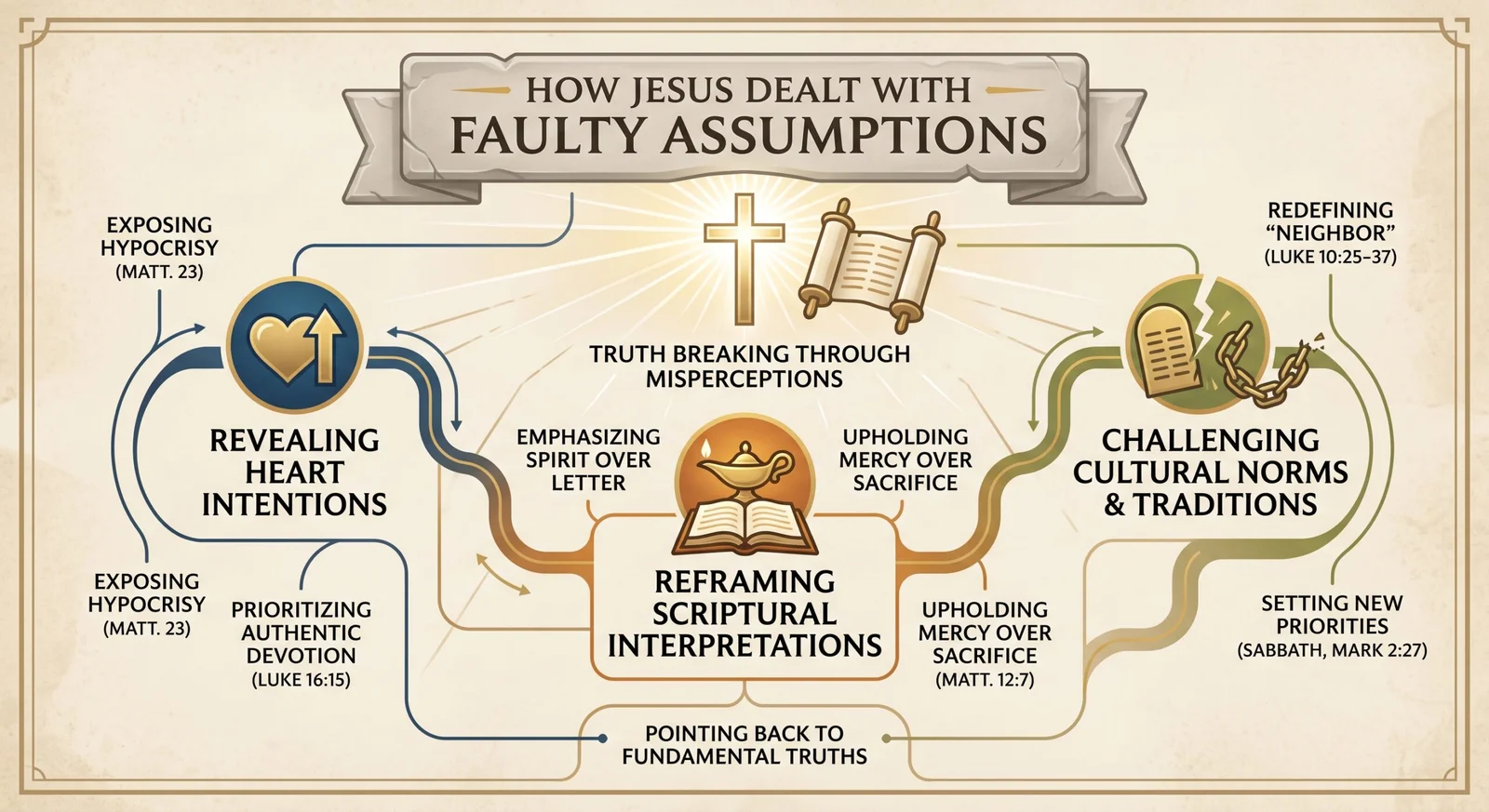
I have seen husbands falsely accusing their wives of infidelity before, and I have also seen wives accusing their husbands falsely of infidelity too.
I have observed the reactions of different couples as they deal with these accusations and how sometimes it leads to irreparable damage, and in some other cases it leads to no damage at all.
How we handle faulty assumptions matters a lot.
Jesus was the best teacher we can ever have in dealing with faulty assumptions.
Imagine meeting Jesus face to face and finally getting the chance to ask the question that has been bothering you for years.
You have thought about it carefully. You have rehearsed it in your mind. Perhaps it is a question about faith, suffering, politics, meaning, or God. You ask it sincerely, hoping for a clear answer.
Instead, Jesus tells a story or asks you a question in return. Maybe he even simply remains silent.
It would be deeply frustrating. Yet, that is exactly what happened throughout the Gospels.
One study found that Jesus was asked 183 questions. Depending on how they are counted, he gave direct answers to only a handful of them. The vast majority received something else entirely: a parable, a counter-question, an illustration, or a response that seemed to address an entirely different issue.
At first glance, this can make Jesus appear evasive. If someone asks a question, surely the obvious thing to do is answer it. Yet the more I have reflected on some of the most famous conversations in the Gospels, the more I have come to believe that Jesus was not avoiding the truth at all. Rather, he recognised that the question people asked was often not the question they really needed answered.
Again and again, those who approached him carried hidden assumptions into the conversation. They had already decided what the problem was, so they framed the issue in a particular way. If Jesus had simply answered their questions, he would have reinforced their assumptions rather than challenged them.
Instead, he did something far more challenging.
He changed the conversation.
Here are a few examples of questions that Jesus refused to answer directly.
Who Is My Neighbour?
One of the clearest examples comes in the famous story of the Good Samaritan.
A lawyer approaches Jesus and asks what he must do to inherit eternal life. Jesus responds by asking him what the law says. In response, the man gives an excellent answer. He must love God with all his heart and love his neighbour as himself.
Jesus tells him he is correct. So in theory, the conversation could have ended there. But Luke tells us that the lawyer, wanting to justify himself, asks a follow-up question:
“Who is my neighbour?”
At first, this sounds entirely reasonable. In fact, it was a genuine question debated within Jewish circles. The command to love one’s neighbour was clear enough, but who exactly counted as a neighbour? Family? Fellow Jews? Friends? Foreigners? Enemies?
The lawyer wants a definition and clarity. He wants to know where his responsibility begins and ends. Most teachers would have offered an explanation.
Jesus tells a story instead.
A man is robbed, beaten, and left for dead. A priest sees him and walks by. A Levite does the same. Finally, a Samaritan stops and helps.
We know the story so well that we sometimes miss how shocking it would have sounded. Jews and Samaritans had centuries of hostility behind them. The Samaritan was the last person anyone expected to become the hero of the story.
Yet Jesus deliberately places him at the centre.
What fascinates me is what happens at the end. Jesus does not say, “Now let me explain who your neighbour is.” Instead, he asks another question.
“Which of these three was a neighbour to the man who fell into the hands of robbers?”
In that moment, everything changes.
The lawyer began by asking, “Who is my neighbour?”
Jesus leaves him asking, “How can I be a neighbour?”
The lawyer wanted a category, but Jesus offered a calling. The lawyer wanted a boundary, but Jesus offered compassion.
Rather than helping him draw lines around who deserved love, Jesus challenged him to become the sort of person who loves. The answer the lawyer wanted would have narrowed the discussion.
The story Jesus told blew it wide open.
Should We Pay Taxes to Caesar?
The next encounter takes place in a very different setting, but the pattern is actually remarkably similar.
A group of Pharisees and Herodians approach Jesus with a question about taxation.
“Is it lawful to pay taxes to Caesar or not?”
On the surface, it sounds like a straightforward political question. In reality, it is a carefully constructed trap. If Jesus says yes, many ordinary Jews will view him as supporting the Roman occupation. If he says no, he can be accused of encouraging rebellion against Rome.
Either answer creates problems, and Jesus recognises the trap immediately.
Rather than responding directly, he asks for a coin. Someone produces a denarius bearing the image of Caesar.
Jesus asks a simple question.
“Whose image is this?”
“Caesar’s,” they reply.
Only then does he say, “Give to Caesar what is Caesar’s, and to God what is God’s.”
For centuries, people have debated exactly what those words mean. Yet what stands out to me is how Jesus refuses to accept the terms of the debate. His opponents want him to choose between Caesar and God, politics and religion, state and faith.
Jesus refuses the false choice.
Instead, he redirects attention to something deeper. The coin bears Caesar’s image and therefore belongs to Caesar’s realm. But human beings bear the image of God.
The discussion begins with taxation and ends with identity. What starts as a question about money becomes a question about belonging.
Once again, the answer people wanted was too small.
By What Authority Do You Do These Things?
The third encounter takes place in Jerusalem after Jesus has entered the city and caused disruption in the temple.
The chief priests, scribes, and elders confront him with a challenge.
“By what authority are you doing these things?”
Unlike the previous example, this sounds like a perfectly fair question. If Jesus is teaching publicly, performing dramatic actions, and attracting crowds, surely people have a right to know where his authority comes from.
Yet Jesus does not answer. Instead, he asks them about John the Baptist.
“Was John’s baptism from heaven, or of human origin?”
Suddenly, the questioners find themselves trapped. If they acknowledge that John’s ministry came from God, Jesus can ask why they rejected him. If they deny John’s authority, they risk angering the crowd, who regard John as a prophet.
The religious leaders eventually settle on an answer that is not really an answer at all.
“We don’t know.”
Jesus responds by saying that he will not answer their question either.
At first, this exchange can feel like clever debating. Yet there is something deeper going on. Jesus is exposing the motives behind the question.
The issue is not that there is insufficient evidence. The issue is that they have already decided what they want to believe, and therefore, any answer Jesus gives will simply be dismissed.
By redirecting the conversation, Jesus reveals that the real problem is not ignorance but unwillingness. The leaders are not seeking understanding. They are seeking ammunition.
That changes everything.
Many of us assume that if enough evidence is provided, people will automatically change their minds. Yet experience tells us otherwise. Sometimes our objections are intellectual. More often, they are personal.
The religious leaders did not need more information.
They needed honesty.
What Is Truth?
The final example may be the most famous of all.
Jesus stands before Pontius Pilate during his trial. Pilate questions him about kingship, power, and authority. Jesus speaks about truth and says that everyone who belongs to the truth listens to his voice.
Pilate responds with a question that has echoed through history:
“What is truth?”
It is one of the most profound questions ever asked, and Jesus never answers it. Pilate does not even wait for a response. He immediately turns and walks away.
The irony is extraordinary.
Throughout John’s Gospel, Jesus has repeatedly pointed to himself as the revelation of God’s truth. Yet Pilate asks, “What is truth?” while standing face to face with the person Christians believe embodies it.
The answer is standing in front of him, but Pilate cannot see it.
His question reveals more about him than it does about truth itself. He approaches truth as an abstract concept, a philosophical puzzle, perhaps even a cynical joke. Jesus has been speaking about truth as something personal, relational, and transformative.
The two men are talking about entirely different things.
Pilate thinks he is judging Jesus, but in reality, the conversation reveals something about Pilate, and perhaps that is why Jesus remains silent.
Sometimes silence can expose more than words ever could.
The Questions Beneath the Questions
When we place these stories side by side, a fascinating pattern emerges.
The lawyer wants a definition.
The Pharisees want a political answer.
The religious leaders want justification.
Pilate wants a philosophical explanation.
In each case, Jesus refuses to answer directly. Not because he lacks an answer or because he is avoiding the issue. It is not even because the question is unimportant.
He refuses because the question itself is too small.
Each question contains assumptions that need to be challenged before a meaningful answer can be given. Jesus understands that simply providing information would leave the deeper problem untouched.
That is why he tells stories and asks questions. That is why he sometimes remains silent.
Jesus taught this way because he was not trying to help people win arguments. He was instead trying to help them see differently.
The same may be true for us.
Looking back, I wonder if many of the questions I have brought to God over the years have suffered from the same problem.
Why is this happening to me?
When will things get better?
What should I do next?
Those questions matter, and God is not indifferent to them. Yet there have been times when I have become so focused on getting an answer that I have missed the possibility that God might be trying to reshape the question itself.
The deeper question is not always the easier one, but it is often the one that changes us.
Sometimes the answer we need is found on the other side of a better question.














Comments (0)
Facebook Comments (0)