
Personalizing Genesis
 admin
Sep 10, 2026
148
0
admin
Sep 10, 2026
148
0
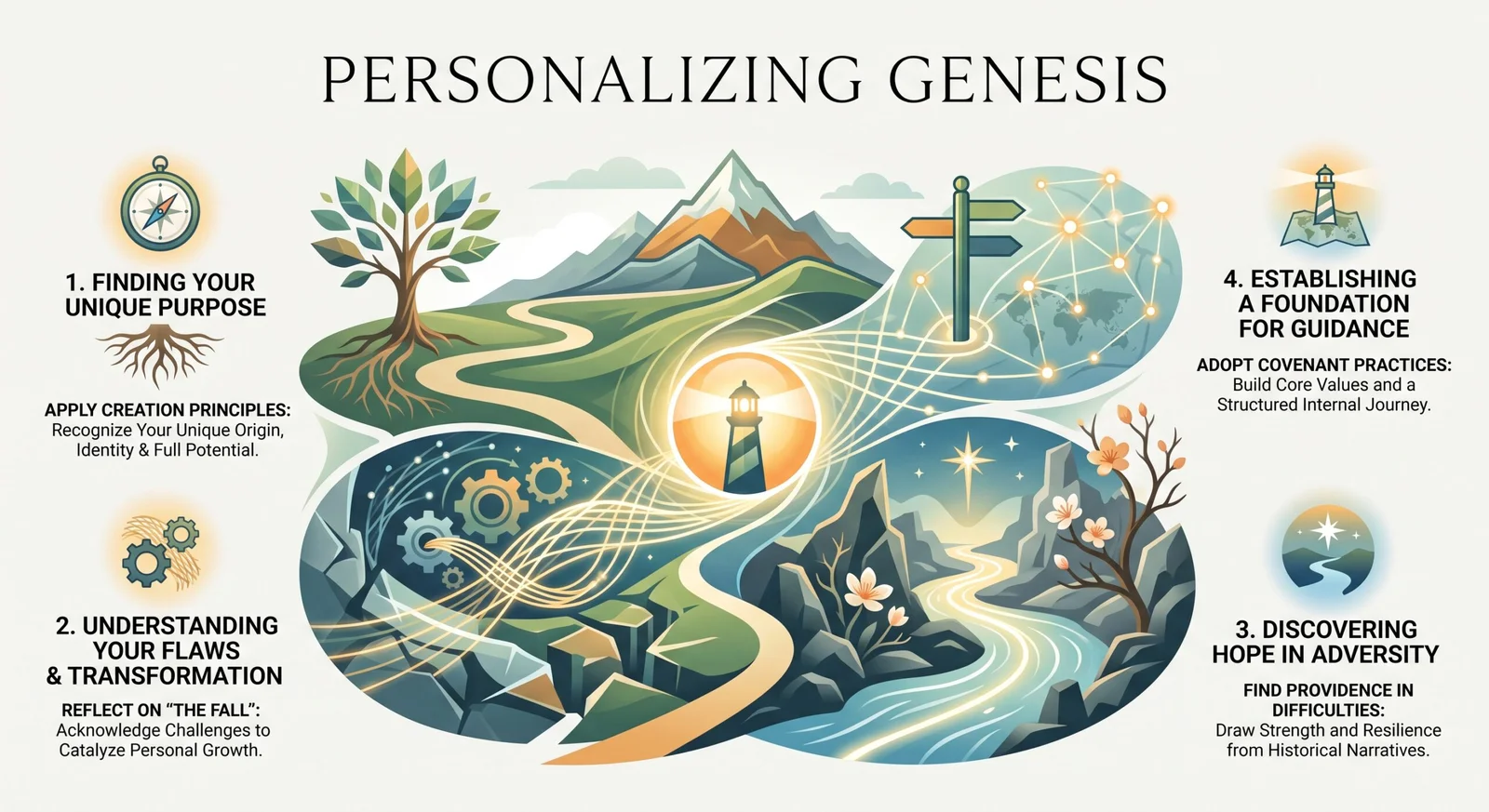
I have always been told that Genesis is where the story begins.
It is the place people go to ask how the world began, why humanity exists, what the garden means, whether Adam and Eve were real, and how any of it should be read now. Those questions matter and will continue to be asked.
Yet it strikes me that we sometimes come to Genesis asking only modern questions, while missing the deeper thing the text is doing right in front of us.
Because Genesis does not just describe the beginning of the world. It describes the beginning of a pattern we still live inside.
That is why it still feels so relevant to us now.
Read carefully, and the early chapters of Genesis do not feel like a cobbled-together way of explaining how we got here. They feel more like recognition. They name the things we still do, the fears we still carry, and the fractures we still live inside. Less like a closed case, more like a diagnosis.
Perhaps that is why these stories endure. They do not merely tell us where we came from. They tell us why life feels the way it does.
That matters because once you read Genesis that way, the text opens up in a different direction. You stop asking only, “Did this happen exactly like this?” and start asking, “Why does this still feel so familiar?”
That question is where Genesis starts to feel like a mirror.
These are not isolated moments in an ancient story.
They are patterns.
The first thing we do is hide.
That detail is easy to miss.
The first response in Genesis is not violence. It is not even open rebellion. It is hiding.
Adam and Eve become aware of themselves in a new way, and almost immediately, they begin to cover and conceal. They hear God in the garden, and instead of stepping forward, they step back.
That still feels familiar.
Most of us know what it is to hide without physically going anywhere. We hide in versions of ourselves. We manage what people see. We reveal enough to appear open while keeping something slightly out of reach.
We do not only fear being wrong.
We fear being seen.
Genesis names something here that we often try to avoid. Shame does not simply make us feel bad. It makes us hide.
When we are confronted, we shift the blame.
The next pattern appears almost immediately.
When the questions come, honesty does not.
Instead, responsibility begins to move.
“The woman you gave me…”
“The serpent deceived me…”
It is a pattern we keep repeating, often without noticing it.
We explain, justify, and redirect. Sometimes those explanations are not entirely wrong. Life is complicated. But Genesis is not just interested in explanation. It exposes something deeper.
Blame protects us in the moment, but it fractures everything around us.
What was once a gift becomes a problem. Relationship becomes defence. Trust begins to erode.
And again, it feels uncomfortably familiar.
Dust and breath
One reason Genesis still resonates is that it names something many of us feel but struggle to articulate.
Life resists us.
Even good things come with friction. Work is meaningful, but tiring. Relationships are beautiful, but difficult. Growth is possible, but often slower than we would like. Love takes effort. Faith takes effort. Hope takes effort. Even the simplest things end up involving sweat.
Genesis names that shift with remarkable honesty. Work exists before the fall, but afterwards it is marked by toil, thorns, and resistance. The world no longer feels effortlessly cooperative. The ground pushes back.
Many of us assume that if life feels hard, we must be doing it wrong. We imagine that a better system, a better routine, a more disciplined self, a more enlightened spirituality, or a more efficient app might finally remove the resistance.
Sometimes things do become easier. I love a good routine. Yet Genesis offers a more sobering and, in its own way, more merciful account.
The friction is not always proof of failure. Sometimes it is simply part of what it means to live east of Eden.
We are not entirely at home
The story ends with expulsion, and that may be the deepest pattern of all.
Human beings leave the garden, and from that point on, the Bible becomes, among other things, a story of exile, longing, wandering, return, and homecoming. Genesis introduces that ache early.
We are alive, but not entirely at rest.
We build, plant, marry, labour, laugh, and carry on. Yet beneath it all, there is often the sense that something is missing and that something is not as whole as it should be.
Many people know this feeling without having religious language for it. Life can be full and good and still carry a note of homesickness.
We achieve things and remain restless.
We belong somewhere and still feel displaced.
We are connected and lonely at the same time. Genesis describes that condition with surprising clarity. To be human is to bear dignity and fracture together. Dust and breath. Glory and vulnerability. Hunger and homesickness.
Yet even in these early chapters, judgement is not the only note. There is also grace.
God clothes the humans who tried to cover themselves badly.
The story of Genesis is not just the spread of sin, but the spread of grace alongside it. Even when the text names what is broken, it does not leave humanity abandoned in the rubble.
That may be why Genesis still matters so much. It is not merely exposing us; it continues to tell a truth in a way that still leaves room for love.
Perhaps that is how these stories were always meant to work.
Not as tidy answers to every modern question, but as ancient words that still tell the truth about us. They describe the patterns we keep repeating: hiding, blame, grasping, toil, and displacement.
They also keep opening the deeper questions beneath them.
What kind of world is this? What kind of creatures are we?
Why are we drawn to what harms us? Why do we fear being seen?
Why does life feel so beautiful and so difficult at the same time?
Genesis does not settle all of that. It does something more interesting.
It starts the right conversation.
And perhaps the next time we read it, that is what we should pay most attention to.
Not only whether we can explain every detail,
but whether the story is explaining us.













Comments (0)
Facebook Comments (0)