
The Proxy Man – Part I
 admin
May 5, 2026
369
0
admin
May 5, 2026
369
0
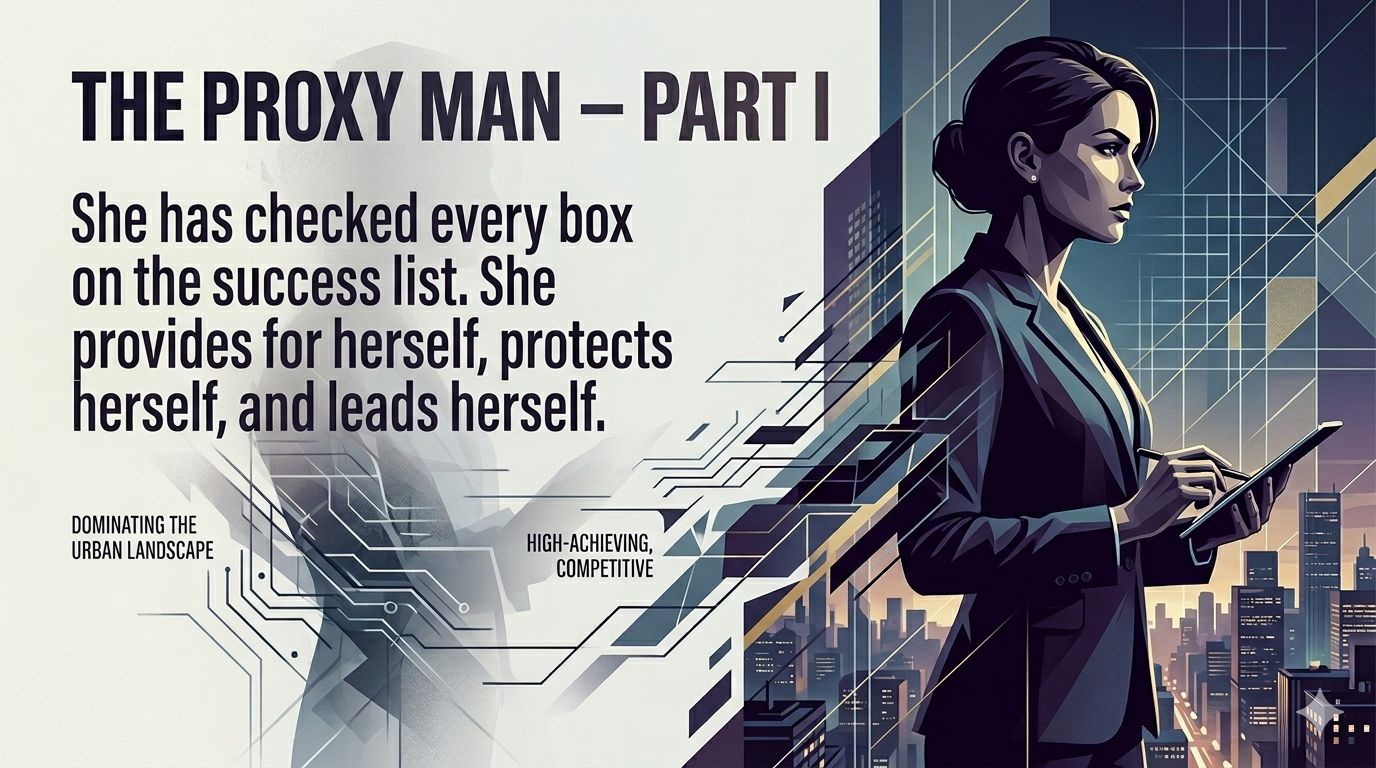
There’s a particular type of woman dominating the urban landscape today.
She has checked every box on the success list. She provides for herself, protects herself, and leads herself. On paper, she’s a triumph of modern ideology.
In reality, she has become a Proxy Man.
A Proxy Man is a woman who suppressed her full range to survive a system that only rewarded half of it. She has adopted every trait of a high-achieving, competitive male — focus, stoicism, and a singular drive for resource acquisition.
“She cut off the parts of herself that were ‘too soft’ for the boardroom — and discovered later that those were the same parts that knew how to be loved.”
This isn’t observation. High-achieving women have described it themselves.
Arianna Huffington, after her 2007 collapse from exhaustion, wrote in Thrive that she had confused achievement with living — that she had built an empire and lost access to herself. She described the floor of her office, where she regained consciousness, as the moment her definition of success broke permanently.
Sheryl Sandberg’s central thesis in Lean In describes a state of permanent battle-readiness that leaves women performing competently even in the absence of threat, treating every room as a negotiation and every interaction as an audition.
These are not weak women. These are women who won — and still described feeling hollowed out by the cost of winning.
When a woman operates within the masculine frame, she creates a vacuum in her life.
Studies on long-term partnership stability consistently identify emotional differentiation — the ability of partners to occupy distinct psychological and functional roles — as one of the strongest predictors of relational longevity. Attachment research consistently finds that long-term intimacy depends on difference, not similarity. Two people who occupy the same psychological role don’t complete each other. They crowd each other.
If a woman is already occupying the masculine space in a relationship — being the provider and the decider — there’s no room for a man to enter.
We’ve told women they don’t need a husband. But we’ve secretly replaced him with an institution.
The corporation provides the health insurance. The side business provides the protection. The salary provides the provision. You haven’t escaped a power structure — you’ve just changed which one owns your hours.
For many women, the Proxy Man wasn’t a manifesto. It was a survival response.
In an economy where a single income can no longer anchor a home. In a dating landscape where men are expected equal burden but offered unequal ground. In a world where depending on a man carried documented financial and personal risk, the Proxy Man was often a rational adaptation to an irrational set of options.
She didn’t abandon love. She decided that exposure without reliable ground wasn’t love — it was risk with worse odds.
She cancels the family holiday to do an extra bit of work
She checks her work email during her own birthday dinner — not because she wants to, but because the machine has trained her that availability is survival. She’s never fully anywhere.
The institution has colonized her attention.
She has become a part-time inhabitant of everywhere she goes.
Acute stress influences decision-making differently in men and women, with women showing significantly greater emotional and physiological residue from stress exposure.
Peer-reviewed studies on oxytocin-testosterone antagonism have consistently shown that sustained high-cortisol, high-testosterone environments suppress the neurological systems most associated with relational bonding and empathy in women.
When women are locked in high-stress competition mode, their capacity for relational empathy drops. Biology is not a metaphor.
A woman who says “I don’t need a man” is technically correct. She can pay her own bills.
But “need” is a shallow word.
Any animal can survive alone.
Relinquishing survival mode — that takes something the self-help industry has no product for.”
Here is the objection.
The real problem isn’t women; it’s a society that never built structures to support them. Better childcare. Equal pay. Men who show up. If those systems existed, the Proxy Man wouldn’t have to.
That objection is correct — and insufficient.
Structural change takes decades. Her cortisol doesn’t care. The argument here is not that women should accept a broken system. It’s that they should stop paying for it with their bodies while waiting for it to change.
Don’t mistake softness for weakness.
True elite status is the capacity to lead a company during the day and choose to be led by your partner at night. It’s the mastery of your own internal gears — a skill that the most powerful women I know have had to fight to reclaim.
If you only have one gear — Attack — you aren’t powerful. You’re broken.
The breaking happens quietly. It shows up in the way she responds to tenderness with suspicion. In the way a compliment lands like a negotiating tactic. In the way she flinches at softness — her own and anyone else’s — because softness was the first thing the machine asked her to give up. Reclaiming the full range isn’t a weekend retreat. It is a slow excavation of the woman she suspended to survive.
Part of her is proud of what she’s built. Another part is quietly exhausted that she had to become this version of herself to build it.













Comments (0)
Facebook Comments (0)